
Home
Watershed
Calendar
Creek News
Projects
Creek Care
Reports
Board
Support
Referrals
Topics discussed on this page include: Habitat Restoration Projects, Invasive Spartina Eradication, Fish Habitat Improvement , Water Quality Testing , Creek Cleanup
Habitat Restoration Projects
For more information:
Funding has been provided by the LEF Foundation, and water for initial irrigation by the Ross Valley School District.
In January 2007, a Marin Conservation Corps (now Conservation Corps North Bay) crew planted almost 500 container plants in the lower section, drove over a hundred individual willow stakes, built an impressive living willow wall, and constructed a willow mattress. In December 2007, a CCNB crew weeded and planted an additional 206 container plants. Nine tree species and sixteen shrubs and forb species were planted.
Very heavy rainfall in January 2008 caused flooding at 300 Olema Road, where water overflowed Fairfax Creek upstream of the box culvert that we had been unable to replace previously. This had two damaging effects on the planted area. By far the worst was caused by fast-moving water emerging from the culvert directed at the left bank of the creek in the planted area, where approximately one-third of the left bank, including the willow mattress and willow wall, were washed away. The second impact was gullying and erosion caused on the right bank by water returning to the creek from Olema Road. In Summer 2008, the undersized culvert at 300 Olema Road was replaced with a larger culvert, reducing the threat to the project area. As of 2010, no funding has been found to replant the eroded area.
Funding was provided by MCSTOPPP, Department of Water Resources Urban Streams Restoration Program, and Ross Valley Sanitary District. The property owner provided irrigation for the first three years.
Funding has been provided by the Marin County Stormwater Pollution Prevention Program.
For more information:
Funding was provided by MCSTOPPP, State Water Resources Control Board Proposition 13 Bonds, and Ross Valley Sanitary District. The Town of San Anselmo provided water for initial irrigation.
Funding of the early planning phases was provided by the San Francisco Estuary Project. Funding for implementation has been provided by the Willis Evans Watershed Habitat Improvement Grant Program of the Marin Municipal Water District. Water for the temporary drip system is donated by the Ross Valley Sanitary District.
Larkspur Creekside Open Space, Larkspur
Funding has been provided by the U.S Fish and Wildlife Service Private Stewardship Grant Program, the Ross Valley Sanitary District and Larkspur Creekside HOA.
Larkspur Creek
Funding has been provided by the Marin County Wildlife and Fisheries Advisory Committee.
Invasive Spartina Eradication
The ISP has researched eradication methods and has followed standard Integrated Pest Management protocols to develop the current treatment techniques. www.spartina.org
We carried out a pilot project at Piper Park in Larkspur starting in 2003. In 2005 through 2008 we treated all of the infestations in the Corte Madera Creek estuary, except for a few isolated spots where individual property owners would not grant permission for the treatment; unfortunately, these untreated plants continue to produce seeds. Follow-up treatments—nearly all involving digging—will be done over the next few years to complete the project. Crews from the Conservation Corps and volunteers do the digging; any spraying is done by licensed contractors. For large marshes where California clapper rails breed, the treatment season is September through January. In other areas, we can dig throughout the year and spray when the plants are growing.
We wish to thank all those property owners who have participated in this project, the aim of which is to maintain the richness of plant and animal life in our marshes.
The second contract funded some of the design and permitting necessary to replace two old fish ladders and install a new one on San Anselmo Creek: at Saunders Avenue in San Anselmo and at Pastori Avenue in Fairfax (with old fish ladders), and at Lansdale Station. Although some steelhead can get through the fish ladders, neither one meets the current standards for fish passage used by NOAA Fisheries and California Department of Fish and Game.
The third contract provided funds to complete the design and permitting of the Lansdale fish passage project.
For all projects, Friends assembled a team of experts, including Stetson Engineers Inc., Michael Love Associates, Ross Taylor and Associates, and Garcia and Associates, Inc. As of late 2010, the designs for the Lansdale Station project had been completed and the permit issued. On behalf of the Town of San Anselmo, we applied to California Department of Fish and Game's Fisheries Restoration Grant Program for construction funding and were selected. The contract is being prepared, with the expectation that it will be executed by mid-June 2011 and construction will take place in summer 2012. Designs for the Saunders project had been developed and show flood-control benefits, but this project requires relocating a sewer through private property, the owner of which is not in favor of the project. For Pastori Avenue, two alternative conceptual designs were developed, but the owner of the bridge has not been willing for any work to be done on his property.
The funding for design and permitting originated with the National Fish and Wildlife Foundation, in collaboration with the National Marine Fisheries Service (NOAA Fisheries), the California Department of Fish and Game, and the California Department of Transportation (Caltrans). The funds were provided by Caltrans as required mitigation for possible impacts on steelhead and salmon from pile driving and other activities undertaken as part of the San Francisco-Oakland Bay Bridge East Span Seismic Safety Project.
For more information:
Water Quality Testing
Friends of Corte Madera Creek's first creek cleanup was held in 1996 in the tidal section of Corte Madera Creek, and with the help of Trout Unlimited, Marin Recycling, and Marin Outdoors, we picked up hundreds of tennis balls, mountains of Styrofoam, old tires and other trash, a hypodermic needle, rat poison and a bottle with a message (the content of which history does not relate). Friends continues to organizes an annual cleanup of the tidal marshes of the Corte Madera Creek as our contribution to the state-wide, and now International, Coastal Cleanup Day each September. Over the last several years the haul of trash and recyclables has been between one-half a ton to one ton each year. The City of Larkspur and the Town of Corte Madera help by picking up and disposing of the trash, and the Golden Gate Bridge, Highway and Transportation District allows us to use the ferry terminal parking lot for staging our cleanup and provides a dumpster to dispose of the collected trash.
Since the flood of 1982 municipalities upstream have organized annual cleanups that take place before the winter rains, to remove trash, and the woody debris and low-hanging branches that are considered impediments to flood water. The benefits of leaving natural debris and low-hanging branches are often overlooked: low branches reduce water velocity and so limit bank erosion, while fallen trees are an essential part of a good fish habitat.
To participate in Friends' late summer cleanup, watch for information in the calendar section of our website or in Creek Chronicles. For information on fall creek cleanups in Fairfax and San Anselmo call each town's volunteer coordinator; for information regarding Ross, contact the Department of Public Works.
Links indicated on this Web site may require Adobe Acrobat Reader 6.0 to be operative. Download the program free from Adobe
Through habitat restoration projects, Friends of Corte Madera Creek has an opportunity to make tangible and dramatic improvements to the watershed's natural environment at a small scale, and often at the same time to involve the community in exemplary and satisfying projects. Most of these projects depend upon volunteer labor and modest grants to cover the costs of plants, planting supplies and temporary irrigation systems; limited professional help may be hired to, for example, remove non-native trees. Projects on private property, where Friends may serve in an advisory role, generally call for professional labor and more significant funding.
PlantIDInvasivePlants.pdf (332 KB)
PlantIDNativeShrubs&Vines.pdf (318 KB)
PlantIDNativeTrees.pdf (344 KB)
Recommended Native Riparian Plants (Word document/332 KB)
Friends of Corte Madera Creek is managing seven volunteer-run revegetation projects on publicly-owned property adjacent to creeks.
Fairfax Creek
Return to top
Shown here: Caley Hirsch’s sixth-grade class; Fairfax Creek, looking downstream.
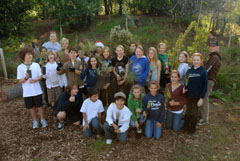
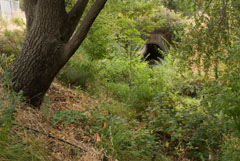
At White Hill Middle School in Fairfax, Friends has been working with two to five classes each year since the fall of 2004 to replace broom and non-native blackberry with native plants along Fairfax Creek and in an adjacent upland area. Upper Fairfax Creek is inaccessible to salmonids owing to a long culvert in downtown Fairfax and a dam adjacent to Olema Road, but wildlife seen on campus by students includes a Pacific giant salamander and tree frogs.
Olema Road, Fairfax Creek
Return to top
Shown here: Fairfax Creek, downstream of 300 Olema Road, with four species of willow planted by Friends.
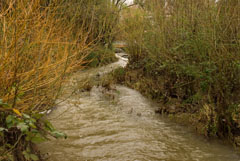
This project consists of two parts. The first was to replace a seriously undersized box culvert at 300 Olema Road and the second was to widen and replant a section reaching approximately 300 feet downstream of the culvert. When the town of Fairfax and the owner of 300 Olema Road could not reach agreement on replacing the culvert, the Town widened the lower portion.
Sleepy Hollow Creek
Return to top
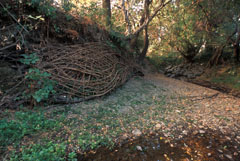
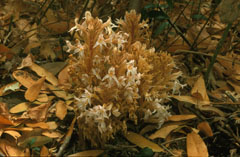
Shown here: Erosion control basket created by Dan McCormick and students; a native broomrape, parasitic on elderberry roots.
On the Drake High School Campus in San Anselmo, between 1997 and 2006 we worked with Sue Fox's students in the SEA DISC Academy on an 830-foot section of Sleepy Hollow Creek between Sir Francis Drake Boulevard and Saunders Avenue. Each year, the academy's new students surveyed existing vegetation, removed invasive non-native plants, and recommended and installed native plantings. The site was originally dominated by acacia, plum, and blackberry, and had suffered a landslide. We have planted 13 species of trees, 25 species of shrubs and vines, and 24 species of grasses, sedges, ferns and forbs. Approximately 180 native and non-native plant species have been observed, including the showy native broomrape (Orobanche vallicola spp.), last reported in the Ross Valley in 1924. Alders planted in 1997 are now over 45 feet tall, and luxuriant willows too have transformed the creek environment into a habitat nurturing much more diverse wildlife. Friends continues to maintain the project. In 2010 the School District is landscaping the area between our project and Sir Francis Drake Boulevard with native plants.
DrakeHighPlants.pdf (67 KB)
Creek Park, San Anselmo Creek
Return to top
Shown here: Conservation Corps North Bay crew builds brush layering. Photo by Prunuske Chatham Inc.
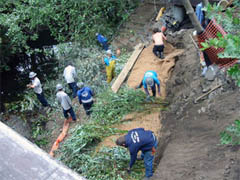
In October 2006 a crew from the Marin Conservation Corps (now Conservation Corps North Bay) replaced riprap and invasive plants with willows and dogwood, using a design for brush layering by Prunuske Chatham Inc. The layering included willow, which prefers a sunny site, and dogwood, a more shade-loving plant, as insurance against variable amounts of sun. The Conservation Corps crew returned in 2006 and 2007 to remove more cape ivy, giant reed, French broom, fennel, and vinca, making room to install over 200 plants representing 20 species. These plants were installed both upstream and downstream of the brush layering. Big-leaf maples, buckeye, coffeeberries, and toyons planted by the Conservation Corps add to the alders, ashes, and willows that were already growing along the creek. Smaller plants installed by the Conservation Corps, including vine honeysuckle, sedges, rush, sticky monkeyflower, snowberry, woodwardia, and ceanothus, are also doing well. Volunteers continue to maintain the site.
College of Marin Ecology Study Area
Return to top
Click for map of Ecology Study Area
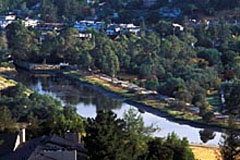
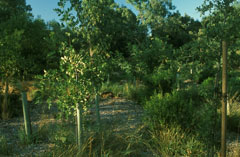
Shown here: The Ecology Study Area lies across the channel; four-year-old trees in an area formerly covered by acacia trees.
This woodland site covers two acres adjacent to the multi-use path that links the college and Marin General Hospital, and is bounded by Corte Madera Creek and a tidal slough. We initiated the project in 1998 by pulling broom and installing a small number of coyote brush plants and oaks. It has developed into a cooperative effort with the College of Marin, and has as its goal the eventual replacement of all eucalyptus and acacia trees on the site with a diverse woodland of native species. In early 2005 a large area was cleared of non-native trees and replanted with nearly 400 native species. A survey was conducted previously to ensure that roosting herons and egrets would be disturbed as little as possible. Friends volunteers continue to remove periwinkle and non-native blackberry to expand the native plantings. When funds become available, more eucalyptuses and acacias will be replaced.
Return to top
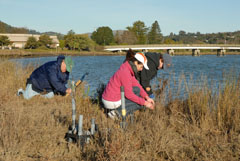
Shown here: Volunteers planting grindelia downstream of Bon Air Bridge
Friends, in collaboration with the Larkspur Creekside Homeowners’ Association, began a project in 2006 to remove invasive exotic vegetation from an area adjacent to a tidal wetland and revegetate with native species. French broom, Harding grass, fennel, ice plant, pampas grass, and small acacias have been removed, and treated areas seeded with the native grasses creeping wild rye (Leymus triticoides spp.) and meadow barley (Hordeum brachyantherum spp.). Two problems make this a challenging site. First, we did not receive permission to remove some nearby tall acacias. Second, domestic geese are fed nearby and they graze on the newly-planted native vegetation, doing severe damage.
The project is maintained by Lisa DiGirolamo, the Project Manager, and Larkspur residents.
Return to top
Larkspur Creek with young live oaks and shrubs planted by Friends.
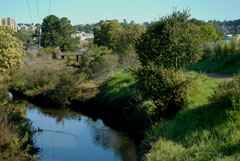
Begun in the fall of 1996, this cooperative endeavor with Redwood High School classes and the City of Larkspur has led to the revegetation of one bank of a largely tidal section of Larkspur Creek between Doherty Drive and Meadowood Drive. The artificial channel is about 1500 feet long, cuts through filled marshland, and bounds the Niven property on two sides. We have removed acacia trees, pampas grass, broom, blackberry and fennel, and replaced them with native plants. The exposed location and poor soil are challenges for revegetation, so plantings have been restricted to 6 species of trees (mainly coast live oak and willow), 7 species of shrubs and vines, and 4 species of grasses, sedges and rushes. As these species grow and provide shade and leaf litter, the environment should become more hospitable to a wider variety of plants. We are anticipating that with the development of the Niven property, riparian vegetation on that side will mirror Friends’ work.
Return to top
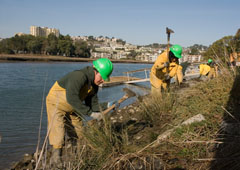
Shown here: The North Bay Conservation Corps has been working with us since 2005.
Friends participates in a project that is underway throughout the tidal marshes of San Francisco Bay to eradicate invasive non-native cordgrasses (Spartina spp.). We receive funding from the California State Coastal Conservancy's Invasive Spartina Project (ISP) to work toward eliminating three species of introduced cordgrasses and their hybrids with the native cordgrass in our estuary. These destructive plants alter both the structure and function of tidal creeks and wetlands, harming native bird, mammal and fish species. Invasive cordgrasses also clog open channels, increasing flood risk and reducing navigability of waterways.
Fish Habitat Improvement
Return to top
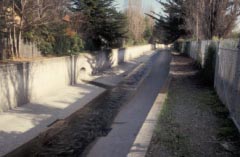
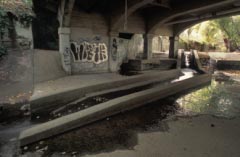
Shown here: The concrete channel in Ross; photo by Lou Vaccaro. Fish ladder under Saunders Avenue, San Anselmo; photo by Charles Kennard.
Friends received two contracts in 2005 and a third in 2008 from the San Francisco Bay Salmonid Habitat Restoration Fund to improve fish habitat in Corte Madera Creek and its tributaries in the Ross Valley. One award to Friends was used to assess barriers to steelhead passage in our watershed and to develop designs to address three different problems that steelhead encounter when they are migrating and when they seek out deep, cool pools necessary for their survival during the summer and early fall. These problems are: inadequate resting pools in the concrete channel in Kentfield and Ross; a poorly designed fish ladder and unstable streambanks immediately upstream of the concrete channel; and other barriers caused by culverts and low dams that keep fish from moving easily between spawning and summer rearing habitat.
BarrierAssessment.pdf (1273 KB)
FishLadderReplacement.pdf (99 KB)
LansdaleDesignReport.pdf (807 KB)
CompleteLansdalePlans.pdf (4 MB)
NewBridgeConcept.pdf (325 KB)
SaundersTM.FINAL.pdf (1 MB)
Return to top
Shown here: Measuring water temperatures in Phoenix Lake with a Hydrolab.Photo by Tom Guldman
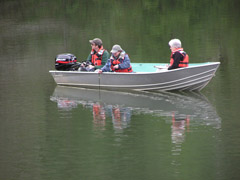
Friends of Corte Madera Creek Watershed strives to ensure that we can safely use our creek for recreation, and that fish and wildlife have the high quality habitats they require to thrive. To this end, our volunteers have participated in the following activities:
TestingNarrative.pdf (110 KB)
WaterQualityTables.pdf (25 KB)
NorthernHalfAerial.pdf (213 KB)
SouthernHalfAerial.pdf (192 KB)
TidalArea.pdf (243 KB)
For several reasons, the bacterial sampling effort has been discontinued. First, because of the complex nature of the watershed (tidal and non-tidal), we were not able to identify the source(s) of the high bacterial counts. Second, it is time-consuming and difficult to organize a high quality, all-volunteer effort and we could not continue to provide that level of commitment. Third, we attempted to obtain funding to implement a professional sampling effort, designed to identify sources, but we have not been successful. We would like to continue the program when funding is available.
BridgeT_DO.pdf (632 KB)
For the past few years, we have noticed a degradation of water quality in upper Ross Creek during the summer when flows are low. Water samples were collected on three days, about a month apart, at four locations covering some 1,600 feet of Ross Creek. For comparison, one sample was collected from San Anselmo Creek at Creek Park, upstream of the confluence of Ross and San Anselmo creeks. Download the technical report describing the results here FeMn_Report_2011.pdf (4300 KB) A summary of the report is in the January-June 2012 issue of Creek Chronicles.
Creek Cleanup
Return to top
Shown here: Tides deposit much of the litter found near the mouth of the creek. Photo by Ann Thomas
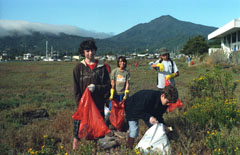 With approximately 20 miles of creeks running through urban areas, it is no wonder that a considerable amount of litter accumulates in our waterways. Additional litter is brought into our estuary by the tide and deposited in the salt marshes. Litter is not only unsightly, but also covers vegetation and can trap or poison wildlife.
Articles relating to topics covered on this page may be found in Creek News.
Photo in logo: Drake High School students construct a basket to control erosion.
All use of text and photographs for other than personal purposes is prohibited without permission from Friends of Corte Madera Creek Watershed.
All photographs © Charles Kennard unless otherwise credited.
Web site design by Karen Peterson, San Anselmo.